
 NEWS List
Fiberglass Duct Rodder Maintenance: 7 Rules to Extend Its Service Life
1. Why Poor Maintenance Leads to Unexpected Breakage and On-Site Delays
Most duct rodder failures do not necessarily begin with one dramatic overload.
Instead, damage often accumulates gradually.
A rod may be repeatedly exposed to:
Abrasion against rough conduit walls
Dirt and sand
Moisture
UV exposure
Repeated bending
Improper rewinding
Impact during transportation
Damaged guide heads
Loose connectors
Excessive pulling force
Over time, these small problems can reduce the reliability of the entire tool.
A Small Defect Can Become a Major Problem
For example, a damaged outer jacket may expose the fiberglass composite underneath. If the damaged section is repeatedly pushed through a rough duct, additional abrasion can occur.
Likewise, a worn connector may initially appear harmless. But when the rod encounters resistance around a bend, the connection becomes a concentrated stress point.
The result can be:
minor damage → repeated stress → local deterioration → failure during a difficult pull.
That is why maintenance should happen before and after field use, rather than only after a failure.
OSHA similarly requires defective pulling lines and accessories to be repaired or replaced in applicable pulling operations.
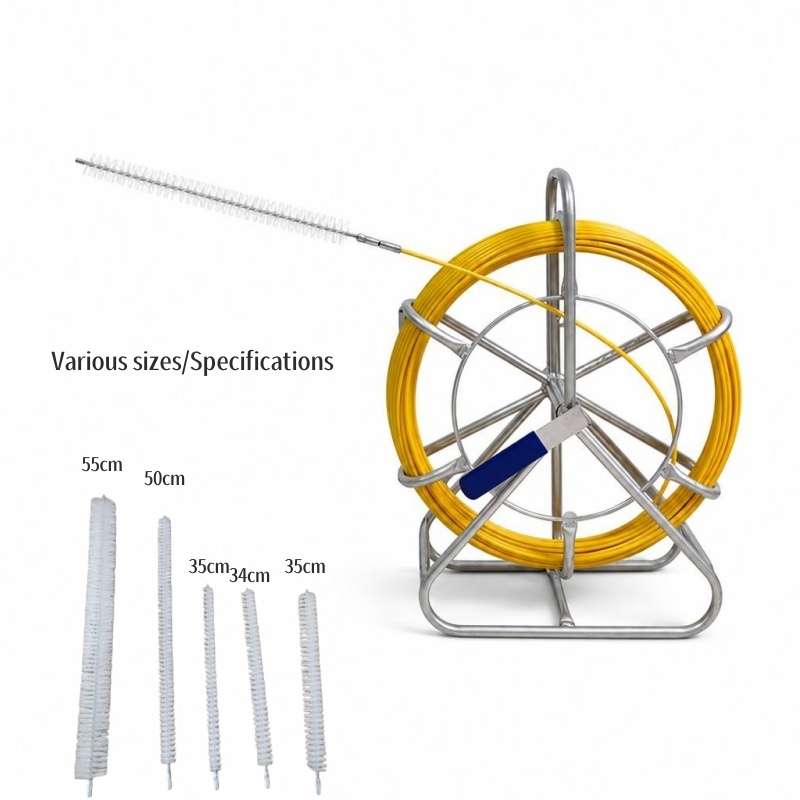
2. Rule 1: Clean the Rod Surface After Each Outdoor Cable Work
The first maintenance rule is also one of the easiest:
Clean the fiberglass rod after every outdoor cable installation job.
A duct rodder can collect:
Soil
Sand
Concrete dust
Mud
Grease
Cable lubricant
Water
Metallic particles
Construction debris
If these contaminants remain on the rod during rewinding, they can be carried into the reel and repeatedly rub against the rod surface.
How to Clean a Fiberglass Duct Rodder
After completing the job:
Step 1: Pull the rod out slowly
Avoid dragging the rod unnecessarily across concrete, asphalt or sharp construction debris.
Step 2: Wipe off loose dirt
Use a clean cloth or suitable soft brush to remove soil and dust.
Step 3: Remove stubborn contamination
If the manufacturer's instructions allow it, use clean water and a mild cleaning method to remove mud or lubricant residue.
Avoid aggressive solvents unless they are specifically approved for the rod's outer coating.
Step 4: Dry the rod
Before long-term storage, make sure the rod surface and reel are dry.
Step 5: Inspect while cleaning
Cleaning provides an excellent opportunity to identify:
Cracks
Deep scratches
Flattened sections
Jacket damage
Exposed fiberglass
Deformed fittings
This simple inspection can catch problems before the next job.
Why Surface Cleanliness Matters
A smooth rod surface helps the rod pass through the duct with less unnecessary contamination and makes defects easier to identify.
The goal is not to make the rod look new.
The goal is to keep the protective surface intact and make developing damage visible early.
3. Rule 2: Rewind Evenly on the Reel to Avoid Sharp Bends and Permanent Deformation
Incorrect rewinding is one of the easiest ways to shorten the working life of a fiberglass duct rodder.
After a long cable-pulling operation, workers may be tempted to rewind the rod quickly and allow sections to cross over each other randomly.
This can create localized bending and mechanical stress.
Keep the Rod in Controlled Layers
During rewinding:
1.Keep the reel aligned.
2.Maintain controlled tension.
3.Guide the rod from side to side.
4.Avoid sudden kinks.
5.Prevent one section from becoming trapped underneath another.
6.Fill the reel evenly.
The rod should form organized layers instead of a random pile.
Why Sharp Bends Are a Problem
Fiberglass rods are designed to flex within a specified bending range.
They are not designed to tolerate uncontrolled kinks or extremely tight localized bends.
A rod that is repeatedly forced into an excessively small bend may experience damage that is not immediately obvious.
This is particularly important with larger-diameter rods because their minimum bending radius is generally greater than that of smaller rods.
For example, published Condux duct rodder specifications show that minimum bending radius increases with rod diameter, illustrating that rod flexibility and strength must be considered together.
Do Not Use the Reel as a Storage Dump
A good reel should keep the rod organized.
However, even a high-quality reel cannot compensate for careless rewinding.
For engineering teams, it is useful to establish one simple operating rule:
The person who finishes the job is responsible for leaving the rodder clean, inspected and evenly rewound.
This turns maintenance into part of the normal installation workflow rather than a separate task that nobody owns.
4. Rule 3: Inspect the Pulling Head and Connector for Wear Before Every Use
The rod itself is not the only component that matters.
The pulling head, connector, threaded fitting and other end components can experience concentrated mechanical loads during duct installation.
Before every use, inspect the end of the rod carefully.
Check These Areas
Pulling Head
Look for:
Deformation
Cracks
Excessive wear
Loose attachment
Damaged threads
Sharp damaged edges
Connector
Check whether:
Threads engage correctly
The connection is tight
There is visible deformation
The fitting has excessive play
The connection shows signs of impact
Rod End
Pay particular attention to the first section of rod near the fitting.
This area can experience higher localized stress during pushing and pulling.
Why Pre-Use Inspection Matters
A damaged end fitting may survive a light straight-line pull but fail when the rod encounters a difficult bend.
That is why inspection should happen before the difficult route, not after it.
OSHA requirements for applicable pulling operations emphasize safe operating condition, rated loads and repair or replacement of defective pulling lines and accessories.
A 30-Second Inspection Checklist
Before feeding the rod:
Pulling head secure
Connector secure
Threads undamaged
Rod end not split
Outer jacket intact
No obvious deformation
Reel rotates normally
Brake works correctly
Wheels/frame appear stable
A short inspection can prevent a much longer site interruption.
5. Rule 4: Store the Rodder Reel in a Dry, Shaded Area Away From Chemicals
Storage conditions have a major effect on long-term equipment condition.
After a construction project, crews may leave the duct rodder outdoors because it will be used again the following day.
Short-term exposure may not immediately cause a failure, but repeated exposure to rain, sunlight, chemicals and construction contamination can accelerate deterioration of components.
Keep the Rodder Dry
Whenever practical, store the equipment in a:
Dry warehouse
Covered workshop
Equipment container
Sheltered storage area
Avoid leaving it permanently exposed to rain.
If the rodder has been used in wet conditions, allow it to dry before long-term storage.
Avoid Direct Sunlight
Fiberglass composite rods commonly use an outer protective coating or jacket.
Long-term exposure to strong UV radiation can contribute to degradation of polymeric materials, so shaded storage is a sensible preventive measure unless the manufacturer specifies otherwise.
Keep Chemicals Away
Do not store the rodder next to:
Solvents
Strong acids
Strong alkalis
Fuel
Industrial chemicals
Unapproved cleaning agents
Chemical compatibility depends on the specific rod coating and reel materials, so manufacturers' storage and cleaning instructions should take priority.
Protect the Reel and Metal Components
The fiberglass rod is only one part of the system.
Storage also protects:
Steel frame
Bearings
Axle
Brake
Wheel assemblies
Threaded fittings
Fasteners
A dry storage environment can help reduce corrosion and prevent avoidable mechanical problems.
6. Rule 5: Avoid Over-Pulling Beyond Rated Breaking Tension
This is the most important maintenance and safety rule.
Never assume that a high-strength fiberglass rod can be pulled indefinitely at its advertised breaking strength.
A product specification may provide several different values, such as:
Tensile strength
Breaking strength
Rated pull strength
Working load
Minimum bending radius
These values have different meanings.
Breaking Strength Is Not the Normal Working Load
Suppose a rod has a very high ultimate tensile value.
That does not mean a contractor should routinely operate the rod close to that value.
Repeated loading near the maximum can accelerate fatigue and increase the consequences of defects, bends or connection problems.
The correct approach is to follow the manufacturer's rated pull strength or working limitation and the requirements of the cable being installed.
OSHA explicitly states in applicable pulling operations that workers must not exceed the load ratings of pulling lines, grips, load-bearing hardware and accessories.
Cable Pulling Force Is Also Controlled by the Cable
For fiber optic cable, the cable manufacturer's maximum installation tension must be respected.
A stronger duct rodder does not make a sensitive cable capable of accepting more pulling force.
The complete pulling system should therefore be considered:
rod → connector → pulling rope → swivel/grip → cable
The allowable load should be based on the weakest applicable component and the manufacturer's instructions.
What to Do When the Rod Suddenly Becomes Hard to Push
Do not simply apply more force.
Stop and investigate:
Is the duct blocked?
Is the route too sharply curved?
Is the rod entering at the wrong angle?
Is the guide head damaged?
Is the duct contaminated?
Is the rod caught on an existing cable?
Is the cable/duct configuration creating excessive friction?
OSHA notes that bends and small conduit can increase pulling resistance and that mechanical assistance may be appropriate when force requirements become excessive.
A sudden increase in resistance is a warning signal—not an invitation to pull harder.
7. Rule 6: Regularly Lubricate Reel Rotating Parts for Smooth Feeding
A duct rodder does not move only because of the fiberglass rod.
The reel assembly also needs to rotate smoothly.
Depending on the design, important moving components may include:
Axle
Bearings
Bushings
Wheel bearings
Brake mechanism
Reel support points
Why Smooth Rotation Matters
A reel that rotates poorly can create:
Excessive payout resistance
Jerky rod feeding
Unnecessary manual force
Uneven rewinding
Increased wear on moving components
OSHA's cable-pulling guidance recommends equipment and spool arrangements that allow smooth movement and reduce unnecessary pulling force.
Use the Correct Lubricant
Do not automatically spray any lubricant onto every moving part.
The correct lubricant depends on the component and manufacturer's maintenance instructions.
A basic maintenance routine can include:
1.Inspect moving parts.
2.Remove dirt and debris.
3.Check for abnormal noise or resistance.
4.Lubricate approved points according to the manufacturer's instructions.
5.Rotate the reel to distribute lubricant.
6.Wipe away excess lubricant.
Do Not Lubricate the Fiberglass Rod Automatically
Rod lubrication and reel lubrication are two different things.
If cable lubricant is required during a pulling operation, use a lubricant compatible with the cable, duct and installation method. Do not treat general-purpose mechanical oil as cable-pulling lubricant.
The objective is to reduce friction where the manufacturer and installation procedure call for it—not to coat every component with oil.
8. Rule 7: Replace Worn Sections in Time for Complex Route Tasks
A common mistake is continuing to use a damaged rod because it still works on easy routes.
This is risky because a weak section may survive a straight, short duct but fail when the rod encounters:
Multiple bends
Long-distance runs
Narrow ducts
Existing cables
High friction
Difficult underground routes
Signs That a Rod Section Needs Attention
Inspect for:
Deep cuts
Cracks
Splits
Flattened areas
Severe abrasion
Exposed fiberglass
Permanent deformation
Damaged end fitting
Unusual flexibility in one section
If the manufacturer provides a repair or replacement procedure, follow it rather than improvising a field repair.
For critical work, a rod with significant structural damage should be removed from service until a competent person or the manufacturer determines whether it can safely be repaired.
OSHA's general approach to pulling equipment is clear: defective pulling lines and accessories should be repaired or replaced rather than continuing to operate them in a defective condition.
Why Early Replacement Saves Money
Replacing a worn component before a major project is usually less expensive than dealing with:
Broken rod inside a duct
Lost installation time
Emergency replacement
Additional labor
Repeated route preparation
Delayed cable installation
For complex telecom and utility projects, preventive replacement is part of productivity management.
9. Low-Cost Spare Parts Preparation Tips for Engineering Teams
Maintenance becomes much easier when spare parts are prepared before they are needed.
A contractor operating multiple duct rodders should consider maintaining a small inventory of common replacement components.
Recommended Spare Parts
Depending on the rodder design, keep:
Replacement pulling heads
End connectors
Threaded fittings
Fasteners
Reel bearings
Wheel bearings
Brake components
Repair kits
Replacement guide heads
Approved cleaning materials
Manufacturer-approved lubricants
Create a “One-Rodder Maintenance Kit”
For each engineering team, a compact maintenance kit can contain:
Item Purpose
Cleaning cloth Remove dirt and lubricant
Soft brush Clean reel and rod
Approved lubricant Maintain rotating components
Spare connector Emergency fitting replacement
Spare guide head Replace worn front component
Basic hand tools Tightening and adjustment
Inspection checklist Standardize pre-use inspection
Maintenance record Track equipment condition
This approach is particularly useful for contractors managing multiple crews.
Track Each Rodder Individually
For larger engineering teams, assign each rodder an equipment number and record:
Date of purchase
Rod diameter
Rod length
Number of projects
Repair history
Replacement parts
Inspection dates
Major damage
Storage location
This creates a simple maintenance history.
After several months, the contractor can identify which rodder is experiencing unusually high wear and investigate the reason.
10. A Simple Fiberglass Duct Rodder Maintenance Schedule
A practical maintenance program can be divided into three levels.
Before Every Job
5-minute inspection:
Check rod surface
Check pulling head
Check connector
Check reel
Check brake
Check wheels
Confirm no obvious structural damage
After Every Job
10-minute maintenance:
Clean rod
Remove dirt from reel
Dry wet components
Inspect for new damage
Rewind evenly
Store correctly
Monthly or Periodic Maintenance
Depending on usage frequency and manufacturer recommendations:
Inspect bearings
Check axle
Check brake
Check wheel condition
Inspect frame
Inspect fittings
Lubricate approved rotating points
Review repair history
Replace worn components
High-frequency contractors may need a more frequent inspection schedule than occasional users.
The manufacturer's maintenance instructions should always take priority over a generic schedule.
11. How Proper Maintenance Reduces Total Cost of Ownership
The financial benefit of maintenance is not limited to extending the fiberglass rod itself.
A well-maintained duct rodder can help reduce several indirect costs.
Lower Replacement Frequency
Early detection of jacket, fitting or mechanical damage can prevent larger failures.
Less Project Downtime
A spare connector or guide head can be replaced much faster than sourcing an entire new rodder after an unexpected failure.
Better Feeding Performance
A clean rod and smoothly rotating reel can make feeding more predictable.
Fewer Emergency Purchases
Maintaining a small spare-parts inventory helps engineering teams avoid expensive last-minute procurement.
Better Equipment Planning
Maintenance records help contractors determine when a rodder should be repaired, refurbished or replaced.
In other words:
Maintenance cost is predictable. Equipment failure cost is not.
12. Contractor Maintenance Checklist
For quick field use, print the following checklist and attach it to the equipment storage area.
Fiberglass Rod
Rod cleaned after previous use
No deep cuts or cracks
No exposed fiberglass
No permanent deformation
Outer coating intact
Pulling Head & Connector
Pulling head secure
Threads undamaged
Connector tight
No excessive wear
Spare fitting available
Reel
Rod rewound evenly
Reel rotates smoothly
Brake works correctly
Bearings checked
Frame undamaged
Wheels
Wheels rotate normally
No cracks or severe wear
Axle secure
Fasteners tight
Storage
Rodder dry
Stored under cover
Protected from excessive sunlight
Away from incompatible chemicals
Spare parts available
Before Pulling
Rod diameter suitable for duct
Minimum bending radius suitable
Rated pull strength confirmed
Cable manufacturer's pulling limit confirmed
Pulling accessories compatible
Route inspected
Communication arranged where required
Conclusion: Maintenance Is the Cheapest Way to Protect a Duct Rodder
A fiberglass duct rodder does not normally fail simply because it is old.
Poor cleaning, careless rewinding, damaged fittings, improper storage, excessive pulling force and delayed replacement can all accelerate wear.
The seven rules are simple:
1.Clean the rod after outdoor work.
2.Rewind it evenly without sharp bends.
3.Inspect the pulling head and connector before every job.
4.Store the reel in a dry, shaded location away from incompatible chemicals.
5.Never exceed rated pulling limitations.
6.Keep approved reel components properly lubricated.
7.Replace damaged or worn components before demanding cable routes.
For contractors, the objective should not simply be to make one fiberglass duct rodder last as long as possible.
The real objective is to maintain safe, predictable and repeatable performance across hundreds of installation tasks.
A disciplined maintenance routine can help reduce unexpected breakage, minimize downtime and maximize the value of the original equipment investment.
And when selecting a new rodder, buyers should look beyond the initial price. A model with replaceable fittings, repairable components, a durable reel, reliable bearings and accessible spare parts can provide a much lower total cost of ownership over the equipment's working life.