
 NEWS List
Heavy Duty Fiberglass Duct Rodder: Contractor Grade Tool for Complex Cable Routes
Introduction: Why Heavy-Duty Duct Rodding Matters on Demanding Job Sites
Underground cable installation rarely happens in perfectly straight, clean and accessible conduits.
Construction contractors, telecom installers and utility crews often have to work with long ducts, multiple bends, partially occupied conduits, underground manholes, rough terrain and repeated daily use. In these conditions, a lightweight consumer-grade duct rodder may not provide enough stiffness, pulling capacity or mechanical durability for the job.
A heavy duty fiberglass duct rodder is designed for exactly this type of demanding work.
Unlike a simple fiberglass cable-pulling rod, a contractor-grade duct rodder normally combines a stronger fiberglass composite rod, durable protective coating, reinforced reel or cage, controlled payout, stable frame construction and replaceable components. The objective is not simply to make the rod stronger. The entire tool needs to withstand repeated handling, pushing, pulling, transport and storage while maintaining reliable performance.
Commercial duct rodder specifications show that pull strength can vary significantly with rod diameter. For example, Condux lists pull strengths from 890 N for a 5 mm rod up to 6,227 N for a 13 mm rod, with larger rods also requiring larger minimum bending radii.
For contractors, therefore, the real question is not:
“Is this duct rodder heavy duty?”
The better question is:
“What specific design features make this duct rodder suitable for my working loads, route conditions and daily usage?”
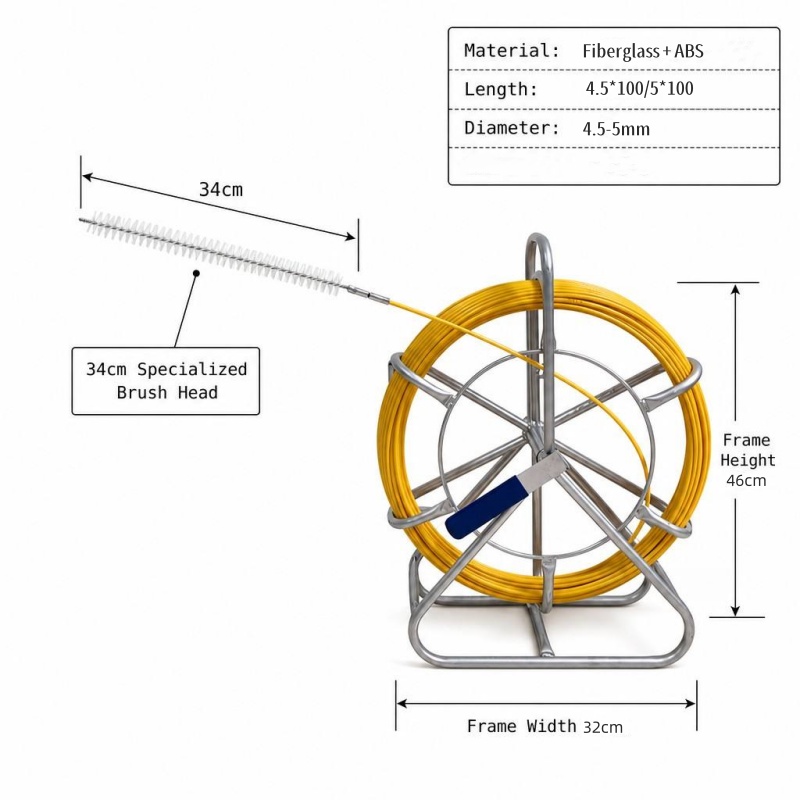
1. What Makes a Rodder “Heavy Duty” for Tough Duct Work?
The term heavy duty duct rodder is not determined by one specification alone.
A professional-grade model should be evaluated as a complete system consisting of:
Fiberglass rod diameter and construction
Rated tensile strength
Rated pull strength
Minimum bending radius
Protective outer coating
Reel or cage strength
Frame construction
Wheel and axle design
Brake system
End fittings
Guide head
Repairability
Replacement parts availability
Overall ergonomics
Heavy Duty Does Not Simply Mean “Thicker”
A thicker fiberglass rod can provide greater stiffness and pulling capacity, but excessive rod diameter can make the tool harder to push through tight bends.
For example, Condux lists 8 mm and 11 mm rods at 4,226 N pull strength, while its 13 mm model reaches 6,227 N. At the same time, minimum bending radius increases from 178 mm for the 8 mm rod to 280 mm for the 11 and 13 mm models.
This illustrates an important engineering trade-off:
Higher strength usually comes with greater stiffness and a larger required bending radius.
A contractor should therefore select rod diameter according to duct diameter, route geometry and required pulling force rather than automatically choosing the largest available rod.
A Real Contractor-Grade Design
A professional duct rodder should also be designed for repeated field handling.
For example, commercial heavy-duty models may use tubular steel alloy frames, corrosion-resistant finishes, hand-operated brakes and large wheels. One published 9 mm GMP configuration uses a powder-coated tubular steel alloy carrier, manual brake and large airless tires, with a rated tensile strength of 45.2 kN and rated pull strength of 6.2 kN.
The important point is that rod strength and machine durability are two different design requirements.
2. High Breaking Tension Fiberglass Core: Performance Under Extreme Pulling Force
The fiberglass core is the structural heart of a duct rodder.
A high-quality fiberglass rod typically uses glass-reinforced composite construction to provide a combination of:
Tensile strength
Compression resistance
Flexibility
Fatigue resistance
Elastic recovery
Electrical non-conductivity
Condux describes its duct rodders as using a glass-reinforced composite core with a rugged plastic jacket, designed for flexural strength, compressive strength, fatigue resistance and long service life.
Breaking Tension vs. Rated Pull Strength
One of the most important points for RFQ evaluation is understanding the difference between breaking tensile strength and rated pull strength.
They should not be treated as interchangeable numbers.
A fiberglass rod may have a very high ultimate tensile strength while its recommended pulling capacity is considerably lower. For example, one published 9 mm GMP duct rodder specification gives:
Rated tensile strength: 45.2 kN
Rated pull strength: 6.2 kN
Minimum bend diameter: 310 mm
This difference is extremely important for professional buyers.
Why Does This Matter?
During duct rodding, the rod is subjected to more than simple straight-line tension.
The rod may simultaneously experience:
Bending around conduit curves
Compression while being pushed
Friction against the duct wall
Local stress at fittings
Repeated cyclic loading
Impact from rough handling
Abrasion from damaged conduit surfaces
Therefore, a responsible contractor should not select equipment based only on the highest advertised breaking force.
Instead, the RFQ should request:
Rated pull strength + minimum bend radius + rod diameter + construction details + test standard.
Match Rod Strength to the Actual Cable Pull
A stronger rod does not mean that the cable itself can safely be pulled with unlimited force.
For fiber optic and other sensitive cables, the cable manufacturer's maximum installation tension remains the controlling limit.
OSHA requirements for applicable underground electrical work also emphasize that pulling lines, load-bearing hardware and related equipment must not exceed their rated capacities, and defective pulling lines or accessories must be repaired or replaced.
The rod should therefore provide an adequate safety margin without becoming an excuse to exceed the cable's allowable pulling tension.
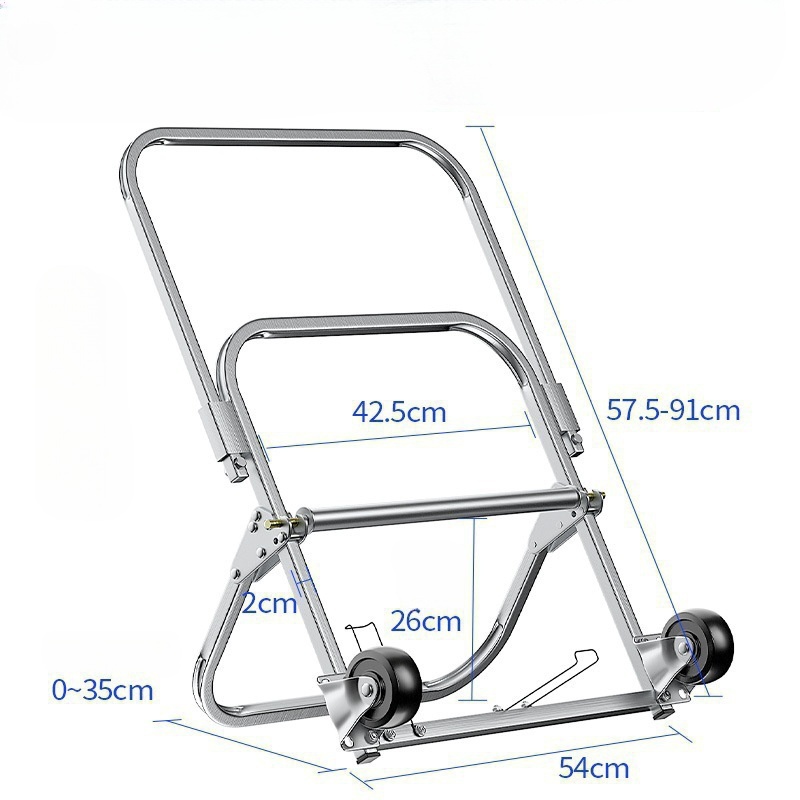
3. Reinforced Reel Frame With Wheels: Easy Transport Across Construction Sites
A heavy-duty rod is only useful if the crew can move it efficiently around the job site.
This is why the reel frame is an important part of a contractor-grade duct rodder.
Longer and larger-diameter rods can become difficult to transport manually. A reinforced steel frame with large wheels can significantly improve mobility between:
Manholes
Utility corridors
Construction trenches
Telecom cabinets
Roadside ducts
Industrial facilities
Building sites
What Should a Professional Reel Frame Include?
A contractor-grade frame should ideally provide:
1. Reinforced structural frame
The frame needs to support the weight of the fiberglass rod while resisting deformation during transport.
2. Large wheels
Larger wheels are particularly useful when the crew needs to move the rodder over uneven ground, gravel, concrete joints or construction debris.
3. Stable axle and wheel mounting
Wheel failure can make a heavy rodder difficult or unsafe to move, especially when the reel is fully loaded.
4. Controlled payout
A brake or controlled reel mechanism helps prevent uncontrolled rod payout.
5. Ergonomic handle
A well-positioned handle allows workers to move the machine without repeatedly lifting or twisting the frame.
Condux's current duct rodder catalog specifically describes sturdy cages, hand-operated wheel brakes and wheels on its 30-inch and 45-inch cages to improve mobility.
That is a good example of why the frame should be evaluated as part of the tool rather than treated as a simple storage cage.
4. Durability Test: How Contractor Grade Rodders Stand Up to Daily Rough Use
A contractor-grade duct rodder may be used hundreds of times during its service life.
The tool may be:
Loaded into a truck
Unloaded at a construction site
Pulled over rough ground
Stored outdoors temporarily
Exposed to dust and moisture
Fed through abrasive ducts
Rewound repeatedly
Used by different workers
Transported between multiple projects
Therefore, durability must be evaluated at several levels.
Rod Durability
The fiberglass rod should have a durable outer jacket that protects the composite core against:
Abrasion
Scratching
Moisture
Dirt
Chemicals encountered in normal field environments
The outer coating is especially important because damage to the jacket can expose the underlying fiberglass structure and accelerate deterioration.
Reel Durability
The cage should resist:
Frame deformation
Corrosion
Repeated impacts
Wheel damage
Brake wear
Bearing or axle problems
Powder-coated steel construction is one common approach for improving corrosion resistance. A published GMP 9 mm model, for example, uses a tubular steel alloy carrier with a powder-coated finish.
Fitting Durability
The rod ends are another critical failure point.
A professional rodder should have properly secured end fittings and a tapered guide head suitable for the intended duct.
Repeated pushing and pulling concentrates stress around these connection points, so buyers should ask whether fittings are:
Replaceable
Mechanically secured
Properly threaded
Compatible with accessories
Supported by replacement parts
Condux, for example, supplies threaded end fittings and tapered heads and also offers replacement rods, fittings and repair kits.
What Should a Contractor Ask for in a Durability Test?
Before purchasing a large quantity, request evidence for:
Test / Inspection Item What to Verify
Tensile test Rated and ultimate tensile values
Pull-strength test Actual rated working pull strength
Bend test Minimum bending radius
Jacket abrasion Resistance to repeated duct contact
Frame test Resistance to deformation
Wheel test Stability under loaded transport
Brake test Controlled payout and stopping
End-fitting test Connection strength and durability
Repeated-use test Performance after cyclic operation
Corrosion resistance Frame/coating performance
A serious manufacturer should be able to explain how these values were obtained rather than simply providing a marketing statement such as “super heavy duty.”
5. Ideal User Profile: Construction Teams, Engineering Contractors and Public Utility Projects
A heavy-duty fiberglass duct rodder is particularly valuable when the equipment will be used repeatedly across demanding projects.
Telecom Construction Teams
Telecom contractors frequently work with:
Fiber optic cables
FTTH distribution ducts
Innerduct
Communication conduits
Manhole-to-manhole routes
Long underground pathways
The rodder can be used to install a pulling line through the duct before the cable installation operation.
OSHA describes rodding as inserting short jointed rods or a long flexible rod into a duct to thread a cable-pulling rope through the conduit.
For telecom contractors, important purchasing criteria include:
Non-conductive fiberglass construction
Suitable rod diameter
Long continuous rod length
High visibility
Durable jacket
Reliable reel
Replaceable fittings
Optional detectable or traceable versions
Electrical Contractors
Electrical contractors may use duct rodders for conduit preparation and cable-pulling operations.
However, electrical applications require careful attention to site-specific hazards and applicable safety procedures.
For underground electrical installations, OSHA requires duct rods to be installed in the direction presenting the least hazard and requires an employee at the far end of the duct line in the circumstances covered by the standard.
Public Utility Projects
Utility contractors often need equipment that can survive repeated deployment over long project cycles.
Typical applications include:
Power conduit
Telecom ducts
Municipal infrastructure
Water and utility corridors
Road construction
Underground infrastructure rehabilitation
For these users, the purchase decision should focus on total operating cost, not simply the initial unit price.
6. Long Service Life Design Details That Reduce Total Ownership Cost
A heavy-duty duct rodder can cost more initially than a basic model.
But the purchase price is only one part of the total cost.
For professional contractors, the more useful calculation is:
Total Cost of Ownership = Purchase Cost + Maintenance + Repairs + Downtime + Replacement Cost + Labor Impact
A durable rodder can reduce several of these costs.
1. Replaceable Fiberglass Rod
A replaceable rod is particularly valuable when the frame and other components remain serviceable.
Condux states that replacement rod assemblies are available for its duct rodders, including end fittings and tapered heads.
This type of serviceability can prevent an otherwise usable reel assembly from becoming obsolete because of rod damage.
2. Replaceable End Fittings
End fittings experience concentrated mechanical stress.
If damaged fittings can be replaced individually, maintenance costs can be significantly lower than replacing the complete rodder.
3. Repair Kits
A repair kit is another practical feature for contractors.
Condux's current catalog states that duct rodders are supplied with a repair kit.
For contractors operating multiple crews, keeping common repair components available can reduce equipment downtime.
4. Durable Outer Coating
A protective jacket helps shield the fiberglass core from repeated contact with the duct.
The longer the rod maintains a smooth, continuous surface, the easier it is to feed through the conduit.
5. Robust Reel and Brake
A strong reel frame can survive repeated transportation and deployment.
A reliable brake also gives workers better control when paying out and retrieving long lengths of rod.
6. Standardized Accessories
A professional duct rodder becomes more valuable when accessories can be replaced or upgraded.
Useful accessories may include:
Tapered heads
Threaded end fittings
Flexible leaders
Swivel couplings
Roller guides
Repair kits
Replacement cages
Guide heads
This type of modularity can extend the useful life of the complete system.
The Real Value of Heavy Duty Construction
The goal is not simply to make a rodder “stronger.”
The goal is to keep the equipment usable, repairable and predictable for years of repeated field work.
That is where contractor-grade construction can create a meaningful return on investment.
7. Quick Checklist to Verify a Real Heavy Duty Model Before RFQ
Before sending an RFQ to a duct rodder manufacturer, contractors should prepare a technical checklist.
Do not ask only:
“Please quote your heavy-duty fiberglass duct rodder.”
Instead, specify the actual performance requirements.
Heavy-Duty Duct Rodder RFQ Checklist
A. Fiberglass Rod
Rod diameter
Rod length
Fiberglass core construction
Outer jacket material
Rod color / visibility
Continuous or jointed design
Non-conductive requirement
Optional detectable core
B. Mechanical Performance
Rated tensile strength
Rated pull strength
Ultimate breaking strength
Minimum bending radius
Compression / push performance
Fatigue resistance
Applicable test method
C. Reel and Frame
Frame material
Frame surface treatment
Reel diameter
Wheel diameter
Wheel material
Axle construction
Brake type
Handle design
Maximum loaded weight
D. End Components
Leading tapered head
Male/female threaded fittings
Fitting material
Replaceability
Accessory compatibility
E. Durability and Service
Jacket abrasion resistance
Corrosion resistance
Repair kit availability
Replacement rod availability
Replacement wheel availability
Replacement fittings
Warranty
Spare-parts supply period
F. Project Requirements
Duct diameter
Duct length
Number of bends
Minimum bend radius
Existing cable occupancy
Required pulling line
Expected frequency of use
Job-site terrain
Transportation requirements
Final Verdict: What Should Contractors Look for in a Heavy-Duty Duct Rodder?
A genuine heavy duty fiberglass duct rodder is much more than a fiberglass rod placed inside a steel reel.
For complex cable routes, the entire system needs to work together:
High-strength fiberglass core + durable protective jacket + reinforced reel frame + controlled brake + reliable wheels + replaceable fittings + serviceable components.
The fiberglass rod determines much of the tool's pushing and pulling capability, but the reel frame determines how easily the equipment survives transportation and daily field use. Meanwhile, replaceable fittings and repairable components can have a major influence on total ownership cost.
Published commercial specifications demonstrate why buyers should compare multiple parameters rather than focusing on one strength figure. Rod diameter, pull strength and minimum bending radius can change substantially between models.
For contractors, the best model is therefore not necessarily the largest or strongest rodder available.
It is the model that provides the right combination of pulling capacity, flexibility, mobility, durability, safety and serviceability for the actual duct route.
Before issuing an RFQ, ask manufacturers to provide measurable specifications—not just the words “heavy duty” or “contractor grade.”
That approach makes it much easier to compare suppliers, avoid under-specified equipment and select a duct rodder capable of handling demanding telecom, electrical and utility construction work.