
 NEWS List
Fiberglass Push Pull Rod vs. Traditional Cable Puller: Which One Fits Your Duct Work?
Introduction: The Pain Points of Old-Style Cable Pulling in Complex Routes
Traditional cable pulling often follows a simple process:
1.Feed a fish tape or pulling line through the conduit.
2.Reach the opposite end.
3.Attach the cable or pulling rope.
4.Pull the cable back through the conduit.
This method works well when the pathway is short, relatively straight, and unobstructed.
The problem appears when the duct becomes longer or more complicated.
Small conduit diameters increase contact between the cable and conduit wall. Multiple bends create additional resistance. Long underground routes can make it difficult for one worker to feed the pulling tool while another worker pulls from the opposite end.
OSHA identifies several factors that increase the physical demands of cable pulling, including conduit diameter, pulling force, repeated pulling and feeding, and bends in the conduit. Manual pulling can involve significant force and repetitive movements of the hands, arms, shoulders, and back.
For fiber-optic installations, the problem is even more critical.
Fiber cables have specific limits for installation tension and minimum bend radius. Corning recommends that installers consider bend radius, pulling tension, jamming, and conduit fill ratio before starting a conduit pull.
Therefore, the goal is not simply to choose the strongest pulling tool.
The better objective is to find a tool that provides:
Sufficient pushing and pulling capability
Smooth feeding through ducts
Good flexibility around moderate bends
Low friction
Reliable cable attachment
Easy transportation
Appropriate tensile strength
Good control during installation
For many telecom, FTTH, utility, and building-cabling applications, fiberglass push pull rods offer a practical balance between these requirements.
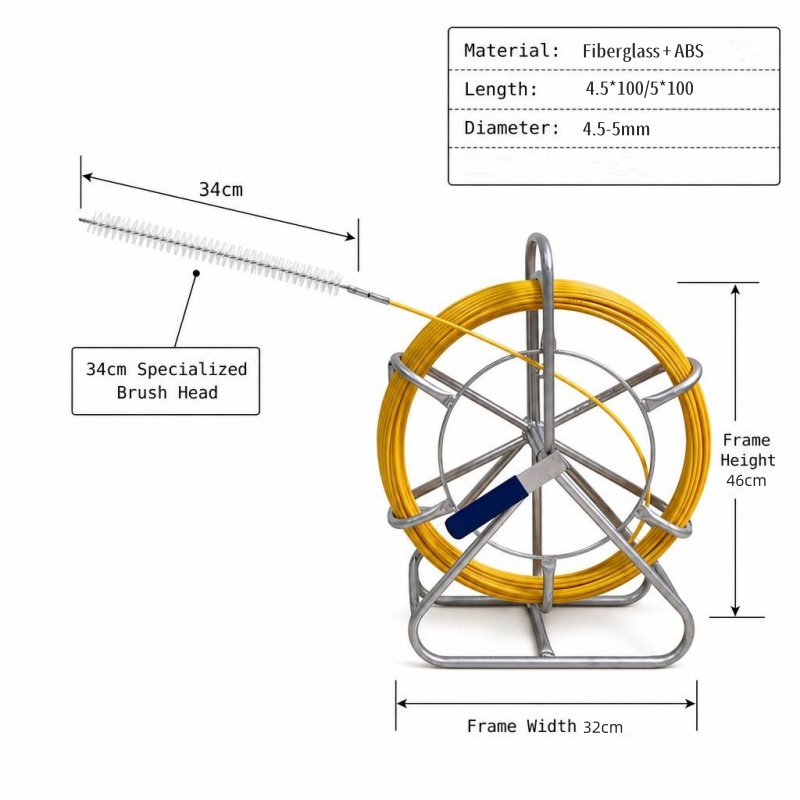
Side-by-Side Performance Comparison: Flexibility, Tensile Strength and Feeding Smoothness
A fiberglass push pull rod and a traditional cable puller are designed for related tasks, but they approach the problem differently.
Performance Factor Fiberglass Push Pull Rod Traditional Steel Fish Tape / Cable Puller
Push capability Excellent for duct feeding Good, depending on design
Pull capability Good to very high, depending on rod diameter Good
Flexibility High Medium to high
Complex duct routing Very suitable Suitable for shorter/simple routes
Long-distance duct work Excellent with appropriate rod diameter Less convenient for manual feeding
Corrosion resistance Excellent Lower for untreated steel
Electrical conductivity Fiberglass itself is non-conductive Steel is conductive
Weight Relatively light Generally heavier
Repeated bends Good with correct diameter Can kink or fatigue
Storage Reel/cage system Reel or case
Typical telecom use Strong fit More limited
FTTH last-mile use Excellent with small-diameter rods Depends on route
Flexibility
Fiberglass has a useful combination of flexibility and spring-like recovery.
A rod can bend when entering a conduit while retaining enough stiffness to transmit pushing force forward.
This is important because a pulling rope alone cannot normally be pushed through an empty duct.
A fiberglass rod can first be pushed through the duct, after which the cable or pulling rope is connected to the rod and brought back through the pathway.
Specialized telecom products demonstrate this principle. For example, Telenco's tooling catalog describes a 3 mm fiberglass micro rod designed specifically for FTTP last-mile deployment, including applications in electrical conduits that are already occupied by other cables.
Tensile Strength
Fiberglass rods are not all the same.
Rod diameter, fiberglass profile, resin system, protective coating, joint design, and end fittings all influence the usable mechanical performance.
For example, KATIMEX product documentation lists different tested tensile strengths and breaking loads for different fiberglass rod profiles.
This means buyers should not compare products only by diameter.
A better specification checklist includes:
Rod diameter
Rod length
Breaking load
Connection strength
Minimum bending radius
End fitting strength
Protective coating
Reel construction
More importantly, the pulling rod must never become the limiting factor that encourages installers to exceed the cable manufacturer's maximum pulling tension.
For fiber-optic cable installation, the cable itself remains the critical limitation.
Corning specifically recommends observing the cable manufacturer's maximum pulling tension and minimum bend radius during installation.
Feeding Smoothness
Feeding smoothness is one of the biggest practical advantages of a well-designed fiberglass duct rod.
A good rod system normally combines:
Low-friction outer coating
Flexible guide head
Smooth reel rotation
Controlled feed-out
Appropriate rod diameter
Suitable pulling eye or connector
Some commercial fiberglass duct rods use polyethylene outer coverings to protect the fiberglass and improve sliding characteristics inside ducts.
This can be especially useful when the rod needs to travel through long underground ducts or existing conduits.
Application Scenario Analysis
1.Small Conduit Cable Routing
For short residential or commercial wiring jobs, a large duct rodder may be unnecessary.
If the conduit is:
Short
Relatively straight
Easy to access
Less than several dozen meters
Equipped with only a few bends
a conventional fish tape can be sufficient.
Fiberglass fish tape is particularly useful in small conduits because it combines flexibility with non-conductive construction. Anixter's cable-installation catalog, for example, describes fiberglass fish tape for telecommunications and data-communication cable installation in areas such as suspended ceilings and under floors.
However, when the route becomes longer or contains multiple bends, a dedicated fiberglass push pull rod becomes increasingly attractive.
Best choice:
Short + simple route → fiberglass fish tape
Longer + more complicated route → fiberglass push pull rod
2.Long-Distance Underground Cable Pulling
Underground duct installation presents a different challenge.
A duct may run:
Between telecommunications chambers
Under roads
Across industrial facilities
Between buildings
Through underground utility corridors
In these situations, installers may need to feed a pulling line through tens or hundreds of meters of duct.
Commercial FRP duct rods are available in configurations ranging from relatively short lengths to several hundred meters. One current product listing, for example, offers fiberglass cable-pulling rods in lengths up to 300–350 meters depending on the selected configuration.
The reel system also becomes important.
A good reel should provide:
Controlled pay-out
Stable transportation
Smooth rotation
Braking capability
Easy rod retrieval
For long underground runs, however, a fiberglass rod is not necessarily a replacement for a powered cable-pulling system.
The better approach is often:
Fiberglass rod → install pulling rope → powered puller → final cable installation
This separates the job of creating the pulling path from the job of applying controlled pulling force to the cable.
The FOA recommends proper lubricants and, for long outside-plant runs, automated pulling equipment with tension control or breakaway pulling mechanisms where appropriate.
3.FTTH Indoor and Outdoor Construction
FTTH projects create some of the most interesting applications for fiberglass push pull rods.
Indoor FTTH routes often involve:
Existing electrical conduits
Narrow pathways
Multiple bends
Suspended ceilings
Floor cavities
Wall penetrations
Multi-dwelling buildings
Outdoor FTTH routes may involve:
Underground ducts
Handholes
Telecommunications chambers
Innerduct
Road crossings
Existing occupied conduits
Telenco specifically markets small-diameter fiberglass micro rods for FTTP last-mile deployment and describes their use in occupied electric conduits.
This is where rod diameter becomes critical.
A 3–4 mm micro rod may be suitable for a narrow indoor FTTH route, while a larger 8–14 mm duct rod may be more appropriate for longer underground ducts.
The tool should be selected according to the pathway—not simply according to the maximum available pulling force.Hidden Cost Comparison: Labor Input, One-Man Operation and Long-Term Durability
The purchase price of a cable pulling tool is only one part of the total cost.
The real cost includes:
Tool cost + labor + installation time + failed pulls + cable damage + transportation + maintenance
Labor Input
Traditional cable pulling can require workers at both ends of a conduit.
One worker feeds the pulling tool.
Another worker waits at the opposite end.
For long or complicated routes, additional workers may be needed to manage cable reels, guide cables, communicate between locations, or deal with jams.
OSHA notes that manually feeding and pulling wire through long conduit runs can involve repetitive, forceful movements and significant physical effort.
A reel-mounted fiberglass push pull rod can simplify the feeding stage because the rod is stored, transported, and deployed as a single system.
This does not mean every job becomes a one-person operation.
Instead, it means the number of workers required for the preparation and feeding stage can often be reduced.
One-Man Operation
One-person operation is most realistic when:
The conduit is accessible from both ends
The cable is relatively lightweight
The route is short to medium
The rod can be fed smoothly
The cable connection is secure
No powered pulling system is required
For large cables, long-distance underground installations, or high-tension applications, additional personnel and mechanical pulling equipment may still be necessary.
The objective should therefore be labor optimization, rather than assuming that every installation can be completed by one worker.
Long-Term Durability
Fiberglass has another important advantage over ordinary steel.
It does not rust in the same way that unprotected steel does, making it attractive for damp or outdoor environments.
However, fiberglass rods are not indestructible.
Repeated sharp bending, excessive loading, damaged coatings, poor storage, and fractured sections can reduce service life.
Professional users should inspect rods regularly for:
Cracks
Splits
Surface damage
Deformed ends
Damaged couplings
Excessive wear
Broken guide heads
A damaged pulling rod should not be treated as safe simply because fiberglass is normally strong.
When to Choose Fiberglass Push Pull Rod Over Metal or Nylon Alternatives
There is no universally best cable-pulling tool.
The correct material depends on the job.
Choose Fiberglass When:
1. You Need Both Push and Pull Capability
A fiberglass rod can be pushed into an empty duct and then used to pull a rope or cable back.
This makes it particularly useful when there is no existing pulling line.
2. The Route Is Long
For longer ducts, a reel-mounted fiberglass rod is easier to deploy than repeatedly connecting short pieces of tape.
3. The Route Has Moderate Bends
Fiberglass provides a useful balance between stiffness and flexibility.
4. You Work Around Electrical Infrastructure
Fiberglass itself is non-conductive.
However, users must still follow electrical safety procedures because end fittings, accessories, nearby metal components, or conductive contaminants can change the safety situation.
OSHA specifically restricts the use of conductive tapes and ropes near exposed energized parts.
5. You Work in Wet or Outdoor Environments
Fiberglass does not have the same corrosion problem as conventional steel.
Choose Steel When:
Steel fish tape may still be preferable when maximum push stiffness is needed over a short, relatively straight route.
It can provide excellent directional control in straight conduits.
Its disadvantages include:
Higher weight
Conductivity
Potential corrosion
Risk of kinking
Less forgiving behavior around tight bends
Choose Nylon When:
Nylon rods are particularly useful for:
Short distances
Tight bends
Indoor customer-premise work
Routes requiring high flexibility
Telenco's tooling catalog, for example, lists a 3 mm nylon thread puller specifically for short routes with many bends in residential and multi-dwelling deployments.
In other words:
Short + many bends → Nylon
Medium/long + balanced flexibility and stiffness → Fiberglass
Short + straight + maximum stiffness → Steel
Very long/high-load cable installation → Fiberglass rod + pulling rope + controlled mechanical puller
Real Case: How a Telecom Team Cut Cable Installation Time by Half
A 50% time reduction should not be presented as a universal performance guarantee.
Instead, consider the following illustrative field scenario.
A telecom team needs to install communication cable through an existing underground duct.
Traditional Method
The team first pushes a conventional fish tape through the duct.
The tape encounters resistance at several bends.
After several attempts, the installer reaches the opposite chamber.
The cable is attached.
Two workers then pull the cable while another worker manages the cable reel.
When the cable encounters resistance, the team stops, checks the route, and repeats the pulling process.
For a difficult route, the total installation process might look like:
Route preparation: 15 minutes
Fish tape feeding: 20 minutes
Cable attachment: 10 minutes
Cable pulling: 30 minutes
Repositioning/troubleshooting: 25 minutes
Total: approximately 100 minutes
Fiberglass Push Pull Rod Method
The same team uses a reel-mounted fiberglass push pull rod.
The rod is fed directly through the duct.
Its guide head reaches the opposite chamber.
A pulling rope is attached.
The rope is pulled back through the duct.
The cable is then connected to the pulling rope and installed using the appropriate pulling method.
A representative workflow could reduce the preparation and feeding stages:
Route preparation: 10 minutes
Fiberglass rod feeding: 10 minutes
Pulling rope connection: 5 minutes
Cable pulling: 20 minutes
Repositioning/troubleshooting: 5 minutes
Total: approximately 50 minutes
This represents a potential 50% reduction in installation time in this particular scenario.
But the actual result will vary substantially according to:
Duct length
Number and radius of bends
Cable diameter
Cable weight
Duct condition
Lubrication
Rod diameter
Worker experience
Cable pulling equipment
Accessibility of both ends
The important point is not the exact percentage.
The important point is that a dedicated fiberglass rod can reduce unnecessary setup, feeding, searching, and repeated attempts.
For professional telecom contractors, saving even 20–30 minutes per installation can become significant when the same operation is repeated dozens or hundreds of times.
Final Verdict: Match Your Tool to Your Project Type
So, which is better: a fiberglass push pull rod or a traditional cable puller?
The answer depends on the duct.
A traditional fish tape remains a practical and economical solution for short, simple wiring routes.
A nylon rod can be a better choice when flexibility is more important than pushing strength.
But when the project involves longer ducts, underground routes, telecom infrastructure, FTTH deployment, or complicated pathways, a fiberglass push pull rod offers a strong combination of flexibility, stiffness, durability, and operational efficiency.
Quick Selection Guide
Project Type Recommended Tool
Short residential wiring Fiberglass fish tape
Short straight conduit Steel fish tape
Short route with many bends Nylon rod
Indoor FTTH Small fiberglass push-pull rod
Occupied conduit Small-diameter fiberglass rod with suitable guide head
Medium telecom duct Fiberglass push pull rod
Long underground duct Heavy-duty fiberglass duct rod
Very long/high-load cable pull Fiberglass rod + pulling rope + mechanical puller
Sensitive fiber-optic installation Tool matched to cable tension and bend-radius requirements
The most important lesson is simple:
Do not choose a cable pulling tool based only on pulling strength. Choose it based on the entire cable route.
The best tool should make the cable easier to install without exceeding the cable's allowable tension or bend radius.
For fiber-optic installations in particular, Corning emphasizes controlling pulling tension, bend radius, sidewall pressure, and conduit conditions.
A fiberglass push pull rod is therefore not simply a replacement for every traditional cable puller.
It is a specialized solution for situations where controlled feeding, flexible routing, long-distance deployment, and reduced manual effort matter more than simply applying maximum pulling force.
For contractors who repeatedly work on telecom ducts, FTTH networks, underground communication infrastructure, and building cable routes, choosing the correct fiberglass rod diameter, length, guide head, reel system, and pulling accessories can turn cable installation from a labor-intensive task into a much more predictable process.