
 NEWS List
Complete Guide to Telescopic High Voltage Measuring Rods: Product Specifications, Industry Applications, and Best Practices
Introduction
Telescopic high voltage measuring rods are indispensable tools for electric utilities, railway maintenance crews, infrastructure inspectors, logistics operators, and emergency response teams. Designed with lightweight fiberglass composite materials and precision telescopic structures, these measuring rods provide accurate distance measurement while maintaining operator safety in demanding environments.
From transmission line sag measurement to railway catenary inspection and warehouse height verification, modern telescopic measuring rods offer versatility, portability, and compliance with international safety standards.
This guide provides a comprehensive overview of product specifications, application scenarios, operating procedures, maintenance recommendations, and available functional accessories.
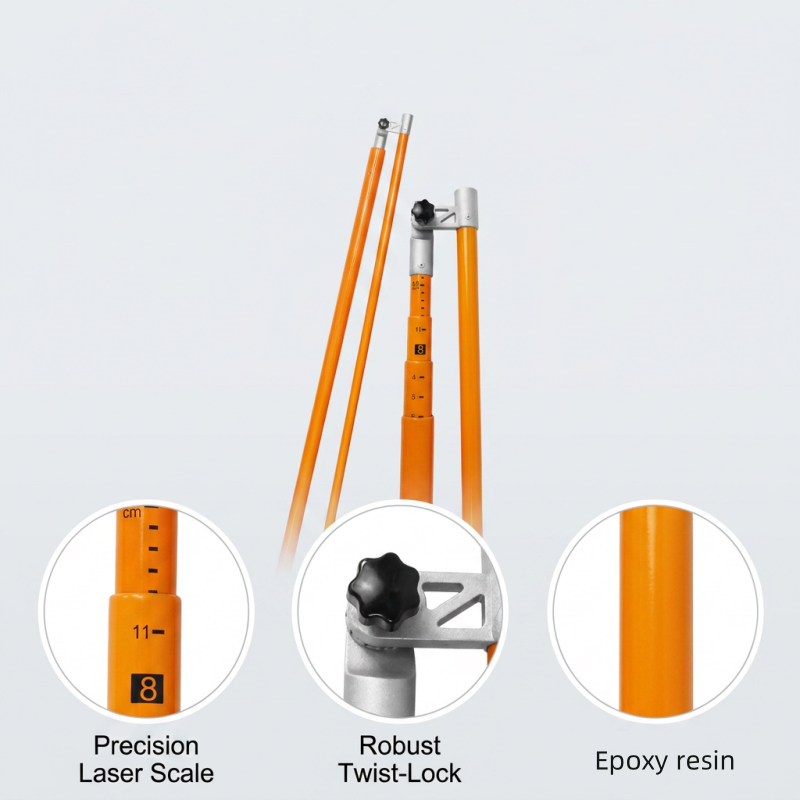
Complete Product Specification Overview
Professional telescopic measuring rods are available in multiple lengths to meet various inspection and maintenance requirements. Each model balances portability with maximum measuring reach while maintaining structural rigidity and measurement accuracy.
CGG Series Model Comparison
The CGG Series is commonly available in several standard configurations suitable for different working environments.
Model Extended Length Retracted Length Approx. Weight Application
CGG-8 8 m 1.2–1.3 m 1.3–1.6 kg Distribution lines, warehouses
CGG-10 10 m 1.3–1.4 m 1.6–2.0 kg Utility inspection
CGG-12 12 m 1.4–1.5 m 2.0–2.4 kg Transmission maintenance
CGG-15 15 m 1.5–1.6 m 2.5–3.0 kg High-altitude inspection
Each model incorporates a multi-section telescopic design with precision locking mechanisms for stable operation during measurement.
Voltage Level Selection Guide
Selecting the appropriate measuring rod depends on the system voltage and the required insulation distance.
Voltage Level Typical Application
10 kV Distribution networks
35 kV Medium-voltage substations
110 kV Regional transmission systems
220 kV High-voltage transmission lines
500 kV Extra-high-voltage power systems
Operators should always follow national electrical safety regulations and utility operating procedures when selecting equipment for energized environments.
Technical Parameter Overview
Although specifications vary by manufacturer, professional telescopic measuring rods generally include the following characteristics.
Parameter Typical Specification
Retracted Length 1.0–1.6 m
Extended Length 6–20 m
Weight 1.25–3.0 kg
Material Fiberglass Reinforced Polymer (FRP) with epoxy resin
Measurement Accuracy ≤1 cm
Outer Diameter Approximately 32–45 mm
Inner Diameter Approximately 24–36 mm
Locking Mechanism Mechanical telescopic locking
Surface Finish Moisture-resistant insulated coating
Lightweight construction allows operators to perform measurements efficiently while reducing fatigue during prolonged fieldwork.
Industry Application Deep Dive
Power Industry
The electrical power sector remains the primary application for telescopic insulated measuring rods.
Typical tasks include:
Transmission line sag measurement
Conductor clearance inspection
Cross-over distance verification
Pole height measurement
Substation equipment inspection
Live-line maintenance support
Accurate measurement helps utilities maintain compliance with transmission safety standards while improving operational reliability.
Railway Transit
Railway electrification systems require continuous monitoring of overhead contact equipment.
Applications include:
Catenary height measurement
Electrical clearance inspection
Tunnel overhead verification
Pantograph operating zone inspection
Maintenance acceptance testing
Regular inspection contributes to railway safety and reliable power delivery for electric trains.
Logistics and Warehousing
Warehouse operators frequently need to verify cargo dimensions and available storage space.
Typical applications include:
Truck cargo compartment height measurement
Warehouse ceiling inspection
Loading dock clearance verification
High-rack storage measurement
Container internal height inspection
The telescopic design enables rapid measurement without requiring ladders or elevated platforms.
Emergency Rescue and Disaster Assessment
Following natural disasters or structural accidents, responders often need to assess inaccessible areas quickly.
Common uses include:
Obstacle height estimation
Building clearance assessment
Bridge damage inspection
Collapsed structure evaluation
Flood response planning
Rescue route assessment
The lightweight design allows emergency teams to transport and deploy the measuring rod rapidly in challenging environments.
Standard Operating Procedure (SOP)
Correct operation ensures both measurement accuracy and user safety.
Step 1: Extend
Remove the rod from its storage case and gradually extend each telescopic section from the smallest section outward.
Step 2: Align
Position the rod vertically or at the required measurement angle, ensuring stable alignment with the target.
Step 3: Lock
Secure each telescopic section using the locking mechanism before taking measurements.
Verify that every section is fully engaged.
Step 4: Read
Read the measurement directly from the graduated scale while maintaining proper rod alignment.
Measurement accuracy typically reaches ±1 cm under normal operating conditions.
Step 5: Retract
After completing measurements, unlock each section in reverse order and retract the rod carefully into its compact storage position.
Daily Maintenance and Storage
Routine maintenance extends service life and preserves insulation performance.
Recommended practices include:
Wipe the rod clean after each use.
Remove dust, mud, and moisture from the surface.
Inspect locking mechanisms regularly.
Check for scratches, cracks, or impact damage.
Store in a dry, ventilated environment away from direct sunlight.
Avoid prolonged exposure to chemicals or corrosive substances.
Perform periodic dielectric testing according to applicable standards.
Proper maintenance helps ensure long-term measurement accuracy and electrical safety.
Functional Accessories and Expansion Options
Modern telescopic measuring rods can be equipped with a variety of interchangeable accessories to enhance functionality.
Voltage Detector Heads
Voltage detector attachments allow operators to verify the presence of electrical voltage before beginning maintenance activities.
Benefits include:
Rapid energized-line verification
Improved operational safety
Reduced inspection time
Additional Functional Attachments
Depending on application requirements, compatible accessories may include:
Hook attachments
Universal operating heads
Fuse handling attachments
Pruning or cutting heads
Inspection mirrors
Camera mounting adapters
Custom utility-specific tools
These modular accessories enable a single telescopic rod to perform multiple inspection and maintenance tasks, improving equipment versatility and reducing overall tool inventory.
Conclusion
Modern telescopic high voltage measuring rods combine advanced fiberglass composite materials, precision engineering, and modular accessory systems to serve a wide range of industries. Whether used for transmission line inspections, railway maintenance, warehouse measurements, or emergency response, these tools provide accurate measurements, enhanced portability, and improved operational safety.
By selecting the appropriate model, following standard operating procedures, and performing regular maintenance, organizations can maximize equipment lifespan while ensuring reliable performance in demanding field conditions.
References
This article is an original technical overview compiled from internationally recognized standards and publicly available engineering references, including:
1.International Electrotechnical Commission (IEC). IEC 60855 Series – Live Working – Insulating Foam-Filled Tubes and Solid Rods.
2.ASTM International. ASTM F711 – Standard Specification for Fiberglass-Reinforced Plastic (FRP) Rod and Tube Used in Live Line Tools.
3.ASTM International. ASTM F1826 – Standard Specification for Live Line and High Voltage Maintenance Tools.
4.ISO. ISO 9001:2015 – Quality Management Systems – Requirements.
5.IEEE (Institute of Electrical and Electronics Engineers). Publications on live-line maintenance practices, transmission line inspection, and electrical safety.
6.OSHA (Occupational Safety and Health Administration). 29 CFR 1910 Subpart S – Electrical Safety-Related Work Practices.
7.EPRI (Electric Power Research Institute). Technical reports on live-line tools, transmission line inspection, and utility maintenance.
8.UIC (International Union of Railways). Technical guidance on overhead contact line inspection and railway electrification maintenance.