
 NEWS List
Professional Cable Rollers for Underground Cable Laying, Pulling, and Trench Work
Introduction
Professional cable rollers reduce pulling tension, prevent jacket abrasion, maintain proper bend radius, and dramatically improve installation speed. Choosing the right roller can save thousands of dollars in labor, prevent costly cable damage, and increase project safety.
This comprehensive guide explains every major type of underground cable roller, the engineering behind nylon wheels, practical selection criteria, and current market trends.
I. Executive Summary
Cable rollers are indispensable in underground cable installation because they:
Reduce friction by up to 70%
Protect cable insulation and sheathing
Maintain minimum bend radius
Lower pulling tension and winch load
Increase installation speed
Reduce manpower requirements
Extend cable service life
Who Should Read This Guide?
This article is designed for:
Electrical contractors
Utility engineers
EPC project managers
Procurement specialists
Telecom installers
Renewable energy developers
What This Guide Covers
All major cable roller types
Nylon wheel material analysis
Product selection framework
Installation best practices
Market pricing and sourcing
Emerging technologies
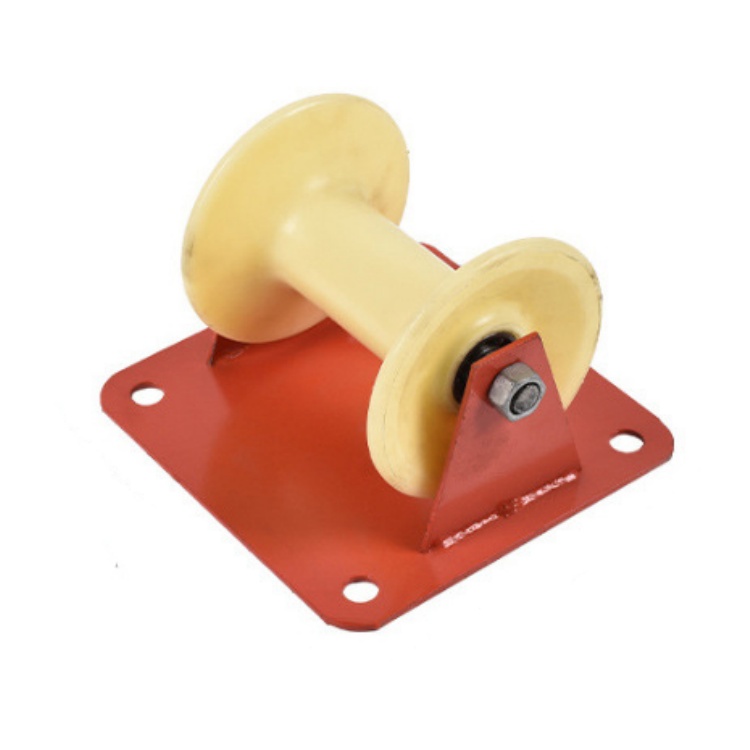
II. The Complete Taxonomy of Underground Cable Rollers
Roller Type Primary Use Typical Load Capacity Wheel Material
Trench Guide Roller Straight trench runs 0.5–5 tons Nylon
Manhole Entry Roller Duct-to-manhole transition 0.5–3 tons Nylon
Corner/Bend Roller Direction changes 1–10 tons Nylon
Pulley Block Roller Heavy pulling and redirection 5–50 tons Nylon / Steel
Duct Feeding Roller Cable entry into ducts 0.3–1 ton Nylon
Ground Haul Roller Surface-level cable pulls 5–30 tons Nylon
Cable Routing Roller General cable guidance 0.5–5 tons Nylon
1. Trench Guide Rollers
These rollers are positioned along straight trench runs to support cable weight and reduce drag. They are commonly spaced every 2–5 meters depending on cable size and terrain.
Key Features
Single or triple nylon wheels
Heavy-duty welded steel frame
High-load sealed bearings
Stable anti-tip design
2. Manhole Entry Rollers
Used where cables enter manholes, vaults, and pull boxes, these rollers prevent cable jackets from rubbing against concrete edges.
Benefits
Protects against abrasion
Maintains bend radius
Simplifies vertical entry
3. Corner and Bend Rollers
Installed at 45°, 60°, and 90° turns, these multi-wheel assemblies guide cable smoothly around bends.
Applications
Street intersections
Building entries
Substation duct banks
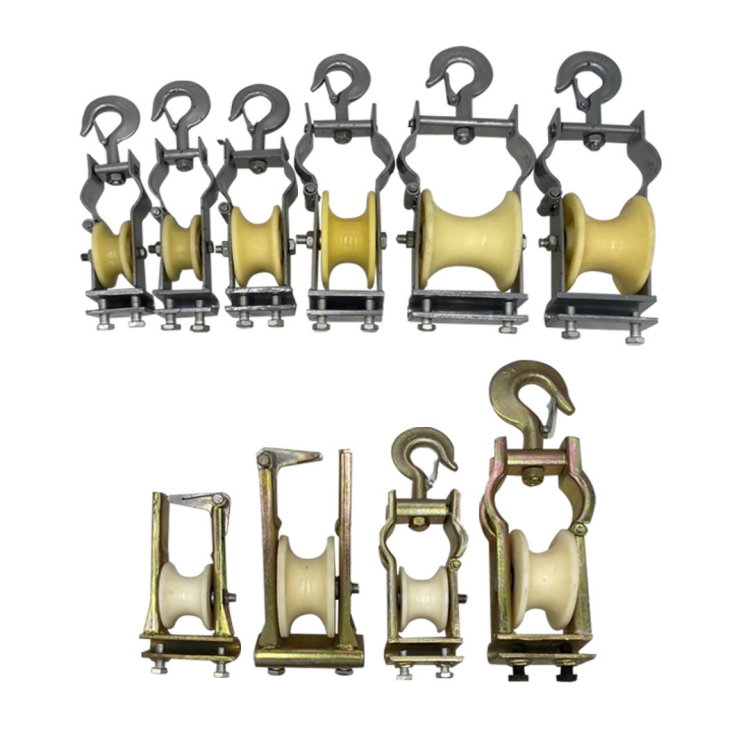
4. Pulley Block Rollers
Designed for high-tension pulling, pulley blocks can handle tens of tons and are often used with winches and stringing equipment.
5. Duct Feeding Rollers
These compact rollers align cable directly into conduits, minimizing friction at the duct mouth.
6. Ground Haul Rollers
Placed on the ground rather than in trenches, these are used for transporting long lengths of cable across construction sites.
7. Cable Routing Rollers
Versatile rollers suitable for both electrical and telecom installations.
III. Nylon Wheel: The Universal Choice — Deep Analysis
Nylon is the preferred wheel material due to its unique balance of strength, wear resistance, and low friction.
Common Nylon Types
Material Characteristics Typical Use
PA6 Economical, strong Standard rollers
PA66 Higher heat resistance Heavy-duty rollers
PA12 Lower moisture absorption Humid environments
MC Nylon Cast nylon with excellent wear resistance Industrial-grade rollers
Mechanical Properties
Typical values for engineering nylon:
Tensile strength: 70–100 MPa
Hardness: Shore D 75–85
Operating temperature: -40°C to 120°C
Low coefficient of friction
Excellent impact resistance
Why Nylon Outperforms Alternatives
Compared with Steel
Won’t scratch cable jackets
Much lighter
Corrosion-resistant
Lower noise
Compared with HDPE/UHMW
Higher load capacity
Better dimensional stability
Superior bearing support
Lifecycle Cost Analysis
Although nylon wheels may cost slightly more than plastic alternatives, their longer service life and lower cable damage risk produce a significantly lower total cost of ownership.
IV. Selection Framework: 10 Questions to Ask Before Buying
1.What cable type and diameter will be installed?
2.What is the maximum pulling tension?
3.What are the trench dimensions?
4.How many bends are present?
5.What is the manhole or duct configuration?
6.What is the total pull distance?
7.Will equipment be used outdoors?
8.What is the project budget?
9.Will the rollers be reused?
10.What warranty and support does the supplier provide?
V. Top Applications Ranked by Roller Demand