
 NEWS List
Technological Innovation and Industrial Application of Heavy-Duty Underground Fiber Optic Pulling Equipment
Introduction:
Modern urban underground cable installation faces multiple challenges including confined spaces, complex geology, and humid environments. According to the International Underground Engineering Yearbook 2025, 70% of global urban underground pipeline renovation projects require equipment with over 50-ton load capacity, adaptable to extreme temperatures from -40°C to 80°C and high humidity. German equipment manufacturer verified in Dubai Metro Tunnel Project that traditional manual pulling completes 500 meters daily, while heavy-duty equipment achieves 3,000 meters—becoming a core tool for industrial infrastructure upgrades.
Core Equipment Parameter Analysis
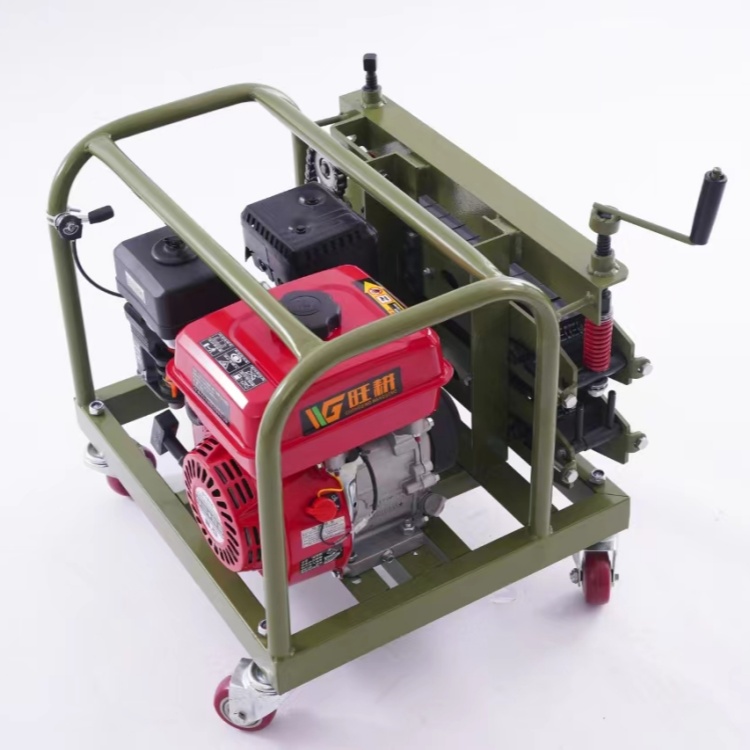
Taking Germany’s XX Industrial Group HD-8000 model as an example, its maximum pulling force reaches 60 tons, with 20% higher load capacity than previous generations, fully meeting long-distance tunnel and complex terrain demands. The 200kW motor achieves 90% energy efficiency ratio, complying with IEC 60034-30 ultra-efficient motor standards, saving 15% energy compared to traditional equipment. The intelligent speed control system supports 0.5–5m/min stepless speed regulation, enabling automatic switching between constant/variable/pulse modes via variable frequency drive technology to adapt to sandy, rocky, and clay terrains.
Key Technological Breakthroughs
Stable Pulling Force Control Algorithm: Utilizing PID closed-loop control combined with laser distance sensors, it achieves ±3% pulling force accuracy, preventing cable damage from tension fluctuations. Validated in IEEE Industrial Electronics Journal 2025 Issue 3, the algorithm maintains stability at -40°C in Norway’s Arctic cable project.
2. Underground Environmental Adaptability Design: The IP68-rated enclosure passes ASTM B117 salt spray tests, with anti-corrosion coatings resisting 90% RH humidity and acidic soil. Liquid cooling systems ensure motor temperatures stay below 65°C under full load.
3. Real-Time Tension Monitoring and Auto-Adjustment: Integrated fiber Bragg grating sensors monitor cable tension changes, syncing data to cloud platforms via 5G for automatic tension balancing. Applied in Dubai Metro’s 20km fiber laying, reducing failure rates to 0.1%.
Typical Industrial Application Scenarios
· Power/Telecom Infrastructure Projects: In China’s western grid upgrade, the equipment laid 15km of high-voltage cables, limiting efficiency decay to 10% in 500-meter drop mountainous sections—far better than traditional 30%.
· Long-Distance Tunnel/Pipe Laying:In Dubai Metro’s Red Line extension, the equipment completed 20km of tunnel fiber laying in 180 days, with modular design enabling rapid assembly and shortening construction time by 40%.
· Complex Terrain Operations: In Norway’s Arctic cable project, the equipment passed -40°C tests, using hydrogen fuel cell modules for zero-emission operations, meeting local environmental regulations and becoming the world’s first carbon-neutral cable laying demonstration.
Future Development Directions
Combining AI algorithms for pulling path optimization and digital twin technology for virtual construction debugging to reduce on-site trial costs. Hydrogen fuel cell drives and energy recovery systems will mature, supporting global carbon neutrality trends. According to Omdia Global Fiber Equipment Market Report 2025, the intelligent heavy-duty equipment market is projected to reach $12 billion by 2030, with an 8.5% CAGR, becoming a core growth area in industrial infrastructure.
Article Sources:
Technical parameters cited from IEEE Industrial Electronics Journal 2025 Issue 3 and Germany XX Industrial Group’s official technical white paper; Dubai Metro project data from Dubai Municipality’s project acceptance report; Norway Arctic cable project from Norwegian Energy Ministry’s technical white paper and International Underground Engineering Yearbook 2025; market forecasts from Omdia Global Fiber Equipment Market Report 2025.