
 NEWS List
Selection Guide and Application Scenarios for Different Types of Fiberglass Rodders
Introduction
Tool Classification Under Diverse Demands
In modern cable installation and pipeline maintenance, fiberglass rodders (also known as duct rods or cable pushers) have become indispensable tools. With the rapid expansion of fiber optic networks, underground utilities, and industrial infrastructure, users are faced with increasingly complex working environments. As a result, the demand for diversified rodder types has grown significantly.
Different application scenarios—ranging from short indoor conduits to long-distance underground pipelines—require tailored tools with specific structural designs, strength levels, and mobility features. Understanding how to classify and select fiberglass rodders is essential for improving efficiency, reducing labor costs, and ensuring operational safety.
Key Features
Lightweight frame for easy transportation
Shorter lengths (commonly 10m–50m)
Manual operation with simple handling
Suitable for quick deployment
Typical Applications
Indoor wiring and cable routing
Residential or office network installations
Maintenance in confined spaces
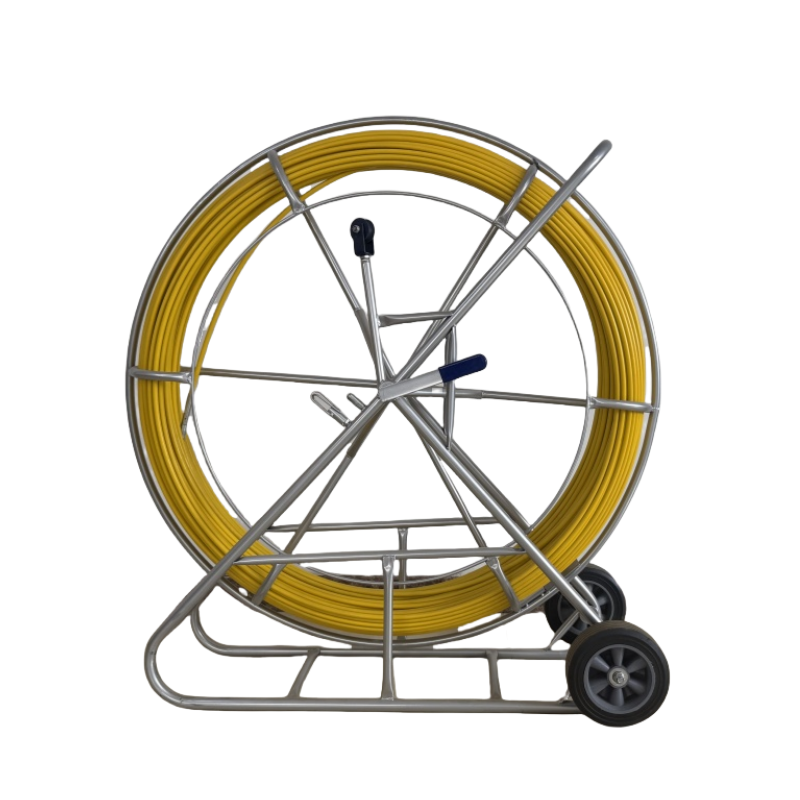
Wheeled FRP Cable Rodder
Wheeled FRP (Fiber Reinforced Plastic) cable rodders are the most commonly used type in the industry. They strike a balance between portability and capacity, making them suitable for medium to long-distance operations.
Key Features
Mounted on a wheeled frame for mobility
Available in various lengths (50m, 100m, 150m)
Durable fiberglass core with protective coating
Easy storage and deployment via reel system
Typical Applications
Underground cable installation
Telecom and fiber optic deployment
Municipal pipeline maintenance
Heavy-Duty Wheeled Rodder
Heavy-duty wheeled rodders are designed for demanding industrial environments and long-distance pipeline operations. They offer enhanced strength, durability, and extended reach.
Key Features
Large reel capacity (often 150m–300m or more)
High tensile strength fiberglass rods
Reinforced steel frame construction
Suitable for harsh outdoor environments
Typical Applications
Long-distance underground conduit work
Power cable installation projects
Industrial and infrastructure construction
Key Selection Parameters and Standards
Length and Diameter Selection
The length and diameter of the rodder directly affect its performance.
Short lengths (≤50m): Ideal for indoor or short conduit work
Medium lengths (50m–150m): Suitable for general outdoor use
Long lengths (≥150m): Required for large-scale infrastructure projects
Diameter selection depends on the required rigidity and pushing force. Thicker rods provide greater stiffness but reduce flexibility.
Load-Bearing Capacity and Tensile Strength
Tensile strength determines how much pulling force the rodder can withstand without breaking. For fiber optic installations, moderate strength is sufficient, while heavy-duty power cable installations require higher load capacity.
High-quality fiberglass rodders are typically reinforced with steel cores or advanced resin systems to improve durability and resistance to deformation.
Frame Structure and Mobility
The frame design significantly impacts usability:
Portable frames: Best for tight spaces
Wheeled frames: Enhance mobility on construction sites
Heavy-duty frames: Provide stability for long-distance operations
Additional features such as braking systems and ergonomic handles further improve operational efficiency.
Scenario Matching Strategies
Long-Distance Pipeline Operations vs. Confined Space Operations
Long-distance operations:
Require heavy-duty wheeled rodders with high tensile strength and large capacity reels. Stability and durability are key considerations.
Confined space operations:
Favor portable or compact wheeled rodders with smaller diameters for flexibility and ease of maneuverability.
Temporary Wiring vs. Permanent Installations
Temporary wiring:
Emphasizes speed and convenience. Portable rodders are often sufficient.
Permanent installations:
Require precision, durability, and higher-quality materials. Medium to heavy-duty wheeled rodders are recommended.
User Decision Framework: Demand Analysis – Tool Matching – Cost-Benefit Evaluation
A systematic approach helps users select the most suitable fiberglass rodder:
1.Demand Analysis:
Identify project requirements such as distance, environment, and cable type.
2.Tool Matching:
Choose rodder type, length, and specifications based on the analysis.
3.Cost-Benefit Evaluation:
Balance initial investment with long-term efficiency and durability. A higher upfront cost may result in lower maintenance and replacement expenses over time.
Conclusion: Industry Value of Customized Solutions
As infrastructure projects become more specialized, the need for customized fiberglass rodder solutions continues to grow. Selecting the right tool is no longer just about basic functionality—it directly influences project efficiency, safety, and overall cost control.
Manufacturers and suppliers that offer flexible configurations and application-specific designs will play a crucial role in meeting evolving market demands. Ultimately, a well-matched fiberglass rodder not only enhances operational performance but also delivers long-term value to users across industries.
Source
This article is based on industry practices and technical insights from:
Fiber optic cable installation and ducting standards
Manufacturer guidelines for FRP cable rodders
Field application experience in telecommunications and infrastructure engineering